
Best-SIP-for-Beginners-In-India-2026
Best SIP for Beginners in India 2026: Complete Beginner’s Guide
If you are new to investing and wondering, “Which is the best SIP for beginners in India in 2026?” then you are not alone.
Many people want to start investing but feel confused because there are thousands of mutual funds available in the market. The good news is that you do not need to be a finance expert to start building wealth.
A SIP (Systematic Investment Plan) is one of the simplest and most disciplined ways to invest for long-term financial goals. Whether you are a salaried employee, business owner, student, or homemaker, SIP can help you build wealth gradually.
In this guide, we will understand:
- What SIP is
- Why beginners should start SIP
- Best SIP categories for beginners in 2026
- How much you should invest
- Common mistakes to avoid
- How to select the right SIP As a financial advisor at Bhavya Investments, I regularly meet people in Jagdalpur and across Bastar who want to start investing but feel confused by the number of mutual funds available. Many people believe they need ₹50,000 or ₹1 lakh to begin investing. In reality, some of the most successful SIP journeys I have seen started with just ₹500 to ₹2,000 per month.
The biggest mistake is waiting for the perfect time. The best time to start investing is usually when you are financially ready and have a clear goal.
Let’s begin.
What is SIP?
SIP (Systematic Investment Plan) is a method of investing a fixed amount regularly in mutual funds.
Instead of investing a large amount at once, you invest small amounts every month.
For example:
- ₹1,000 per month
- ₹2,000 per month
- ₹5,000 per month
- ₹10,000 per month
The money gets automatically invested into the selected mutual fund scheme.
This helps investors develop a disciplined investment habit while reducing the impact of market volatility.
Why SIP is Best for Beginners
Before starting your investment journey, make sure you have an adequate emergency fund. Read our detailed guide on Emergency Fund Planning to create a strong financial foundation.
Many beginners fear stock market fluctuations.
SIP solves this problem because it allows you to invest regularly regardless of market conditions.
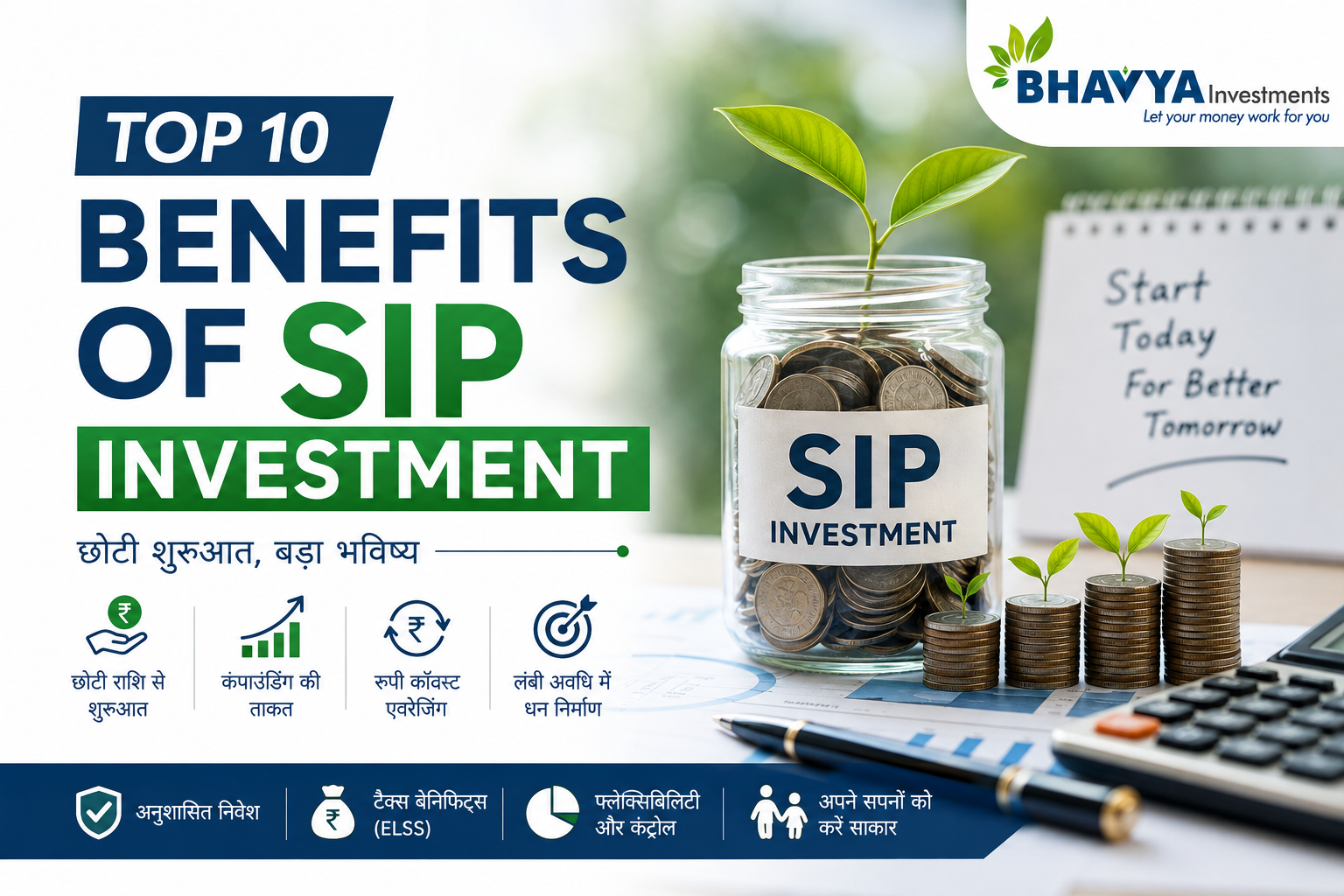
Benefits of SIP
- Start with Small Amounts You can start investing with as little as ₹500 per month. There is no need for a large lump sum investment.
- Rupee Cost Averaging When markets fall, your SIP buys more units. When markets rise, your SIP buys fewer units.
Over time, this helps average your purchase cost. 3. Disciplined Investing Most people fail to invest consistently. SIP automates investing and removes emotional decisions. 4. Power of Compounding The earlier you start, the more time your money gets to grow. Even small monthly investments can become substantial over long periods. 5. Flexible and Convenient You can:
- Increase SIP
- Decrease SIP
- Pause SIP
- Stop SIP Anytime as per your financial situation. One common pattern I have noticed among investors in Jagdalpur is that many people start a SIP enthusiastically but stop it during market corrections.
Interestingly, those who continue investing during market falls often benefit the most in the long run because they accumulate more units at lower prices.
What Makes a SIP Suitable for Beginners?
Before selecting a mutual fund, beginners should focus on
Consistent Long-Term Performance Do not chase last year’s top-performing fund.
Look for consistency over 5–10 years.
Strong Fund Management Experienced fund managers generally handle market volatility better.
Large Assets Under Management (AUM) A reasonable fund size often indicates investor confidence.
Risk Level Understanding your risk appetite is extremely important before selecting a SIP. If you are unsure whether you are a conservative, moderate, or aggressive investor, try our Risk Profiler tool before making an investment decision.
Beginners should avoid highly volatile thematic or sector funds.
Investment Objective Your SIP should match your goal:
- Wealth creation
- Child education
- Retirement
- House purchase
- Financial freedom
If retirement is one of your major financial goals, use our Retirement Planner to estimate how much corpus you may need in the future.
Before selecting a SIP, it is important to define your financial goals. Our Goal-Based Planner can help you identify the right investment amount for your future goals.
Best SIP Categories for Beginners in India 2026
Instead of searching for a single “best SIP”, beginners should focus on the right category.
Instead of searching for the highest-return mutual fund, focus on choosing a category that matches your risk profile and investment goal.
In my experience, first-time investors generally feel more comfortable starting with Index Funds, Large Cap Funds, or Balanced Advantage Funds before moving toward higher-risk categories.
- Index Funds Best For:
- Passive investors
- Cost-conscious investors Index funds simply track market indices such as Nifty 50 or Sensex. Advantages:
- Low expense ratio
- Transparent
- Simple to understand Many experts consider index funds an excellent starting point for beginners. Investment Horizon: 5+ years
- Large Cap Funds Best For:
- New investors
- Conservative investors
- Long-term wealth creation Large-cap funds invest in India’s biggest and most established companies. Examples include businesses like leading banks, IT companies, and consumer brands.
Advantages:
- Relatively stable
- Lower volatility compared to mid-cap funds
- Suitable for beginners Investment Horizon: 5+ years
- Flexi Cap Funds Best For:
- First-time investors
- Long-term investors Flexi cap funds can invest across:
- Large-cap stocks
- Mid-cap stocks
- Small-cap stocks The fund manager can adjust allocation according to market conditions. Advantages:
- Diversification
- Flexibility
- Good long-term growth potential Investment Horizon: 5–10 years
- Balanced Advantage Funds Best For:
- Conservative beginners
- Investors worried about market volatility These funds dynamically allocate between:
- Equity
- Debt Advantages:
- Reduced volatility
- Better risk management
- Suitable for first-time investors Investment Horizon: 3–5 years
Best SIP Fund Types Beginners Can Consider in 2026
Some popular categories that many financial advisors recommend evaluating include: Nifty 50 Index Funds Suitable for investors seeking simple market-linked growth.
Flexi Cap Funds Suitable for diversified long-term investing.
Large Cap Funds Suitable for stable wealth creation.
Balanced Advantage Funds Suitable for cautious investors.
Remember, the best SIP for you depends on:
- Age
- Income
- Risk appetite
- Investment goals
- Time horizon There is no single mutual fund that is best for everyone.
How Much SIP Should a Beginner Start?
Not sure how much you should invest every month? Use our SIP Calculator to estimate your future wealth corpus based on your monthly investment amount and investment horizon.
A common question is
“How much should I invest in SIP?” Here is a simple guideline: Beginners ₹1,000 – ₹3,000 per month Salaried Employees ₹5,000 – ₹15,000 per month Professionals and Business Owners ₹10,000+ per month A good rule is: Invest at least 10–20% of your monthly income.
As your income grows, increase your SIP every year.
SIP Example: Power of Long-Term Investing Successful investing is not just about choosing a mutual fund. It is about following a goal-based investment strategy aligned with your life objectives. Learn more in our detailed guide on Goal Based Investing.
Let’s understand with an example.
Suppose Rahul starts:
- SIP Amount = ₹5,000/month
- Investment Period = 20 years Total Investment: ₹12 lakh Imagine two investors from Jagdalpur.
Amit starts a SIP of ₹3,000 per month at age 25.
Rohit starts a SIP of ₹6,000 per month at age 35.
Even though Rohit invests more every month, Amit may create a larger corpus because his investments get more time to compound.
This example highlights why starting early matters.
If investments grow at a reasonable long-term market-linked return, the final corpus could be significantly higher due to compounding.
This demonstrates why starting early is often more important than investing large amounts later.
Common SIP Mistakes Beginners Should Avoid
- Chasing Past Returns Many investors choose funds only because they delivered high returns last year. Past performance does not guarantee future performance.
- Stopping SIP During Market Falls Market corrections are normal. Stopping SIP during downturns can hurt long-term wealth creation.
- Investing Without Goals Always define a goal before starting. Examples:
- Retirement
- Child education
- House purchase
- Wealth creation
- Choosing Too Many Funds Beginners often invest in 8–10 funds unnecessarily. Start with 1–3 quality funds.
Keep it simple.
- Ignoring Annual SIP Increase As income grows, SIP should grow too. Even a 10% annual increase can dramatically improve future wealth.
As a financial advisor, the most common mistake I see is investors chasing funds that delivered the highest returns last year.
Unfortunately, yesterday's top-performing fund may not remain the best performer tomorrow.
Consistency and discipline are usually more important than chasing short-term performance.
How to Select the Right SIP in 2026
Follow this simple process: Step 1: Define Your Goal Why are you investing?
Step 2: Decide Time Horizon
- Less than 3 years
- 5 years
- 10 years
- 20 years Step 3: Understand Risk Appetite
- Conservative
- Moderate
- Aggressive Step 4: Choose Fund Category
- Large Cap
- Flexi Cap
- Index Fund
- Balanced Advantage Fund Step 5: Start SIP Begin immediately.
Waiting for the “perfect market timing” often delays wealth creation.
Is 2026 a Good Time to Start SIP?
Over the last few years, investor awareness has increased significantly in Jagdalpur, Bastar, and other parts of Chhattisgarh.
Earlier, most families depended mainly on Fixed Deposits, gold, and real estate.
Today, many investors are adding SIPs to their financial plans for retirement, children's education, and long-term wealth creation.
The best time to start SIP is when you are financially ready.
No one can consistently predict market highs and lows.
SIP works because it focuses on:
- Discipline
- Regular investing
- Long-term wealth creation Instead of trying to time the market, focus on staying invested.
Investing is important, but protecting your family is equally important. Many investors focus only on wealth creation and ignore financial protection. Before increasing your SIP investments, ensure your family has adequate life and health insurance coverage. Use our Insurance Need Analysis tool to assess whether your current life and health insurance coverage is adequate.
My Suggestion to Beginners If you are starting your first SIP in 2026, do not worry about selecting the perfect fund.
Focus on three things:
- Start early
- Invest regularly
- Stay invested for the long term These three habits are often more important than trying to find the highest-return fund. Final Thoughts Already investing in mutual funds? Review your current investments using our Portfolio Health Score tool and identify areas for improvement.
For beginners in India, SIP remains one of the most effective ways to start investing in 2026.
Rather than searching for a single “best SIP”, focus on selecting the right mutual fund category based on your goals and risk profile.
For most beginners, categories such as:
- Nifty 50 Index Funds
- Flexi Cap Funds
- Large Cap Funds
- Balanced Advantage Funds can provide a strong starting point. The key is not finding a perfect fund.
The key is starting early, investing regularly, and staying invested for the long term.
Remember
Time in the market is generally more powerful than timing the market.
Frequently Asked Questions (FAQs) Which SIP is best for beginners in India in 2026?
For most beginners, Index Funds, Flexi Cap Funds, Large Cap Funds, and Balanced Advantage Funds are commonly considered suitable starting options.
Can I start SIP with ₹500?
Yes. Many mutual funds allow SIP investments starting from ₹500 per month.
Is SIP risk-free?
No. Mutual funds are market-linked investments and carry risk. However, SIP helps manage volatility through regular investing.
Can SIP Make Me a Crorepati?
Yes, a disciplined SIP combined with long-term investing and periodic increases in investment amount can help you build a corpus of ₹1 crore or more over time.
Which SIP is Best for Salaried Employees?
For most salaried employees, Index Funds, Large Cap Funds, and Flexi Cap Funds are commonly considered suitable options for long-term wealth creation. The right choice depends on your financial goals and risk appetite.
How long should I continue SIP?
Ideally, continue SIP for at least 5–10 years or longer to benefit from compounding.
Can I stop SIP anytime?
Yes. SIPs are flexible and can usually be modified, paused, or stopped as per your financial needs.
Should I Continue SIP During Market Crashes?
Yes. Continuing your SIP during market falls allows you to buy more units at lower prices, which can benefit long-term wealth creation.
Should I choose one SIP or multiple SIPs?
Beginners can start with 1–3 carefully selected funds rather than investing in too many schemes.
What is a Step-Up SIP?
A Step-Up SIP allows you to increase your SIP amount periodically, helping your investments grow along with your income.
Is ₹1,000 Enough to Start SIP?
Yes. Starting with ₹1,000 per month helps build the habit of investing, and you can increase the amount later as your income grows.
About the Author
Mahaveer Jain Founder – Bhavya Investments 📍 Jagdalpur, Bastar, Chhattisgarh 📞 9407799444 Financial Advisor | Mutual Funds | SIP Planning | Insurance | Retirement Planning Mahaveer Jain is a financial advisor based in Jagdalpur, Chhattisgarh, helping individuals and families with Mutual Funds, SIP Planning, Health Insurance, Term Insurance, Retirement Planning, and Financial Planning.
Through Bhavya Investments, he focuses on simplifying financial decisions and helping investors build long-term wealth through disciplined and goal-based investing.
Call To Action Confused about which SIP is right for you?
Bhavya Investments helps families, salaried employees, professionals, and business owners choose suitable mutual fund investments based on their financial goals and risk profile.
Helpful Financial Planning Tools
✔ SIP Calculator ✔ Goal-Based Planner ✔ Retirement Planner ✔ Insurance Need Analysis ✔ Risk Profiler ✔ Portfolio Health Score
📞 Call/WhatsApp: 9009977444
Book your personalized financial planning consultation today and start your wealth creation journey with confidence. Whether you are starting your first SIP or reviewing your existing investments, Bhavya Investments can help you create a personalized investment strategy aligned with your financial goals.
Related Reading
If you're completely new to SIP investing, start with our beginner's guide:
What Is SIP? A Complete Beginner's Guide to Starting SIP Investments in 2026
SIP vs Lump Sum Investment: Which Is Better for Wealth Creation in India? https://bhavyainvestments.com/blog/sip-vs-lump-sum-investment-which-is-better-for-wealth-creation-in-india
Explore More Resources
Visit our website for more educational articles on:
- SIP Investment
- Mutual Funds
- Financial Planning
- Retirement Planning
- Health Insurance
- Term Insurance
🌐 https://bhavyainvestments.com
Disclaimer:
Mutual Fund investments are subject to market risks. Please read all scheme-related documents carefully before investing. Past performance is not indicative of future returns.