
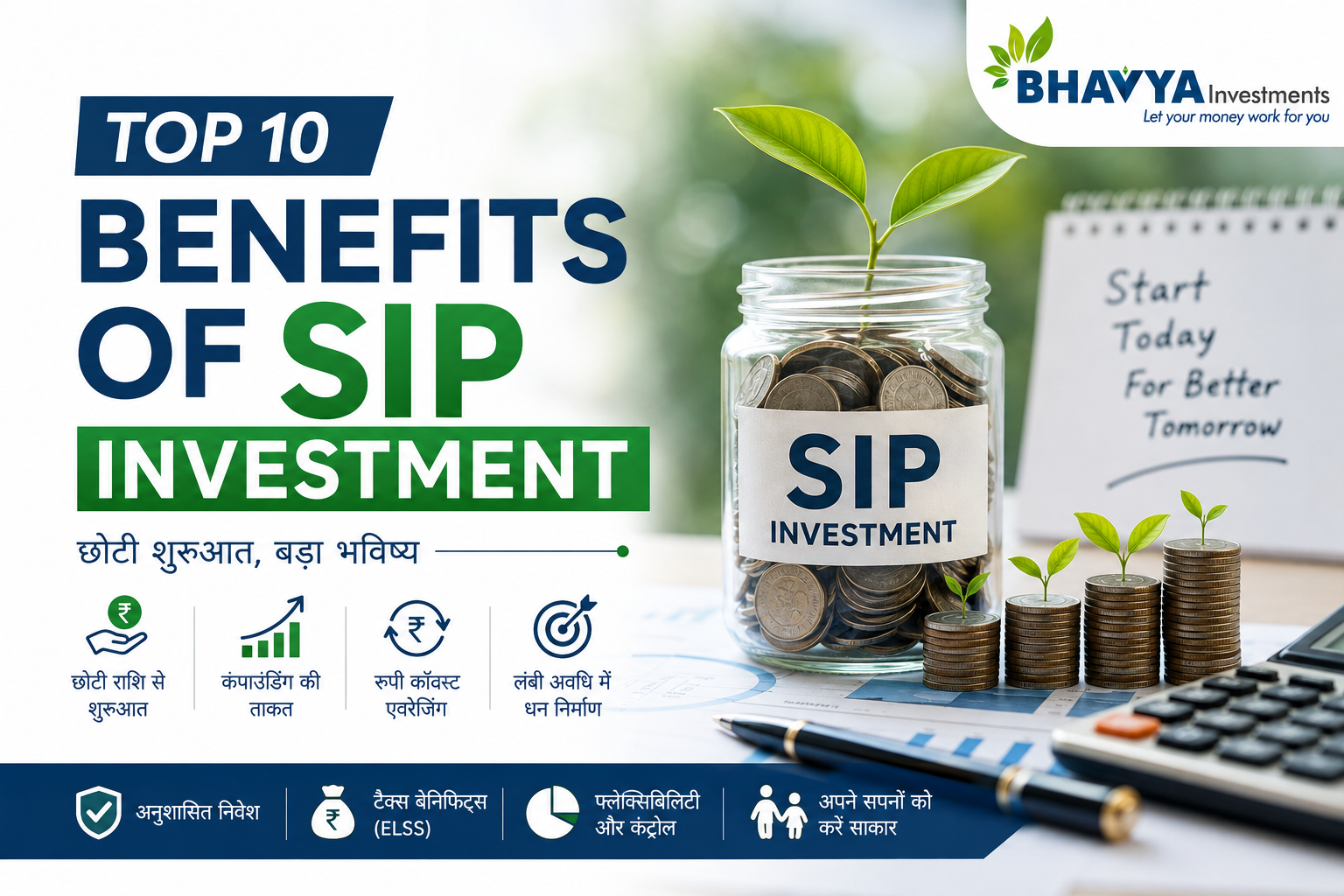
Top 10 Benefits of SIP: Why Every Investor Should Start a SIP in 2026
If you're planning to build wealth but feel confused about when to invest, how much to invest, or where to start, a Systematic Investment Plan (SIP) can be one of the simplest and most effective solutions.
SIP allows you to invest a fixed amount regularly in mutual funds. Instead of waiting until you have a large amount of money, you can start with as little as ₹500 per month and gradually build wealth over the long term.
Whether you're a salaried employee, business owner, student, or homemaker, SIP offers several advantages that make investing easier and more disciplined.
What is SIP?
A Systematic Investment Plan (SIP) is a method of investing a fixed amount regularly in mutual funds. Instead of investing a large sum at one time, SIP allows investors to invest monthly or at regular intervals, helping build wealth through disciplined investing and the power of compounding.
Let's explore the top 10 benefits of SIP.
- Start Investing with a Small Amount
One of the biggest advantages of SIP is affordability.
You don't need lakhs of rupees to begin investing. Many mutual fund schemes allow investments starting from just ₹500 per month.
This makes SIP an excellent option for beginners and young investors.
Example:
₹500/month ₹1,000/month ₹5,000/month
Choose an amount that comfortably fits your monthly budget.
- Develops Financial Discipline
Successful investing is more about consistency than timing.
With SIP, a fixed amount is automatically invested every month, helping you develop the habit of saving and investing before spending.
Over time, this disciplined approach can create a substantial investment corpus.
- Rupee Cost Averaging
Stock markets go up and down regularly.
When markets are low, your SIP buys more mutual fund units.
When markets are high, it buys fewer units.
This process is known as Rupee Cost Averaging, which helps reduce the impact of market volatility over the long term.
Instead of worrying about market timing, SIP lets you invest consistently.
- Power of Compounding
Albert Einstein reportedly called compounding the eighth wonder of the world—and for good reason.
The earlier you start investing, the more time your money gets to grow.
Your returns begin generating additional returns, creating exponential wealth over time.
Example
Suppose you invest ₹5,000 every month for 25 years.
With long-term market-linked returns (which are not guaranteed), investing ₹5,000 every month for 25 years can potentially create a substantial corpus depending on market performance. The actual corpus will vary based on market performance and the duration of investment.
The key ingredient is time, not necessarily a large investment amount.
- Flexibility to Increase, Pause or Stop
Life changes, and your investments should be flexible too.
With SIP, you can:
Increase your SIP amount Reduce investment (depending on fund/platform features) Pause SIP temporarily Stop SIP anytime
There is generally no long-term lock-in for most open-ended mutual fund SIPs (except specific categories like ELSS).
- No Need to Time the Market
Many investors delay investing because they are waiting for the "perfect" market level.
The reality is that predicting the market consistently is nearly impossible.
SIP removes this pressure by investing automatically every month regardless of market conditions.
Instead of timing the market, you spend time in the market, which has historically been a more effective long-term approach.
- Suitable for Every Financial Goal
SIP can help you prepare for multiple life goals.
Examples include:
Child's education Retirement planning Buying a house Buying a car Vacation planning Wealth creation Emergency corpus
Different financial goals can have different SIPs based on your investment horizon and risk profile.
- Professionally Managed Investments
When you invest through mutual funds, your money is managed by experienced fund managers and research teams.
These professionals continuously analyze:
Companies Industries Economic trends Market opportunities
This gives individual investors access to professional portfolio management without needing to research every stock themselves.
- Potential to Beat Inflation
Keeping all your money in a savings account may not always help your wealth grow faster than inflation.
While mutual funds are subject to market risk and returns are not guaranteed, equity-oriented SIPs have historically provided the potential for long-term wealth creation that may outpace inflation over extended periods.
This can help preserve and grow your purchasing power over time.
- Easy, Convenient and Automatic
Starting a SIP today takes only a few minutes.
Once your SIP is registered:
Money is auto-debited Investments happen automatically No need to remember monthly investments Easy online tracking Simple portfolio management
This convenience helps investors stay consistent with their financial goals.
Who Should Start a SIP?
SIP is suitable for:
Salaried employees Business owners Self-employed professionals Young investors First-time investors Parents planning for children's future Individuals planning retirement
In short, almost anyone who wants to build wealth gradually can benefit from a disciplined SIP strategy.
Common Myths About SIP
Myth 1: SIP gives guaranteed returns.
Reality: SIP is a mode of investing. Returns depend on the performance of the mutual fund and market conditions. Mutual fund investments are subject to market risks.
Myth 2: SIP is only for beginners.
Reality: Even experienced investors use SIP to invest systematically and avoid emotional decision-making.
Myth 3: You need a large income.
Reality: You can start with just ₹500 per month.
How to Start a SIP
Starting a SIP is simple:
Define your financial goal.
Assess your risk profile.
Choose suitable mutual funds.
Decide your monthly investment amount.
Complete KYC.
Register your SIP.
Review your investments periodically.
If you're unsure about selecting the right fund, seek guidance from a qualified mutual fund distributor or financial advisor.
Final Thoughts
A SIP is not a shortcut to instant wealth, but it is one of the most disciplined and practical ways to build long-term financial security.
By investing regularly, staying patient, and giving your investments enough time, you can work toward achieving important life goals with greater confidence.
Remember, the best time to start investing was yesterday. The next best time is today.
Frequently Asked Questions (FAQs)
- What is the minimum amount required to start a SIP?
Many mutual funds allow SIPs starting from ₹500 per month.
- Can I stop my SIP anytime?
Yes. Most open-ended mutual fund SIPs can be stopped or paused without penalties, subject to platform and scheme rules.
- Is SIP risk-free?
No. SIP invests in mutual funds, and mutual fund investments are subject to market risks.
- Is SIP better than a lump sum investment?
It depends on your financial situation, available funds, investment horizon, and market conditions. SIP is generally preferred for regular income earners.
- How long should I continue a SIP?
For long-term wealth creation, staying invested for 5–10 years or more is generally considered beneficial, depending on your goals.
SIP is not about getting rich quickly—it's about building wealth consistently. Starting early, investing regularly, and staying invested for the long term can make a significant difference in achieving your financial goals.
If you're looking for SIP investment guidance in Jagdalpur, Chhattisgarh, Bhavya Investments can help you choose mutual funds based on your financial goals and risk profile.
About the Author
Mahaveer Jain is the Founder of Bhavya Investments, a financial advisory firm based in Jagdalpur, Chhattisgarh. He helps individuals and families make informed financial decisions through SIPs, mutual funds, insurance, retirement planning, and personalized financial planning.
Ready to Start Your SIP Journey?
Choosing the right mutual fund is just as important as starting early.
At Bhavya Investments, we help you:
- Select SIPs based on your financial goals
- Build a personalized investment plan
- Review your portfolio regularly
- Stay disciplined throughout your wealth creation journey
📞 Contact Bhavya Investments
Need help choosing the right SIP?
Book a personalized financial consultation today and start investing with confidence.
🌐 Website: https://bhavyainvestments.com
📍 Jagdalpur, Chhattisgarh, India
📲 Contact us through our website or WhatsApp to schedule your consultation.
Related Articles
Continue learning about SIP and mutual fund investing with these helpful guides:
-
Best SIP for Beginners in India 2026: Complete Beginner's Guide to Start Investing
https://bhavyainvestments.com/blog/best-sip-for-beginners-in-india-2026 -
SIP vs Lump Sum Investment: Which Is Better for Wealth Creation in India?
https://bhavyainvestments.com/blog/sip-vs-lump-sum-investment-which-is-better-for-wealth-creation-in-india -
What Is SIP? A Complete Beginner's Guide to Starting SIP Investments in 2026 https://bhavyainvestments.com/blog/what-is-sip-a-complete-beginner-s-guide-to-starting-sip- investments-in-2026
Explore More Resources
Visit our website for more educational articles on:
- SIP Investment
- Mutual Funds
- Financial Planning
- Retirement Planning
- Health Insurance
- Term Insurance
🌐 https://bhavyainvestments.com
Disclaimer
Mutual Fund investments are subject to market risks. Read all scheme-related documents carefully before investing. Past performance is not indicative of future results.